
Best overall for residential dementia support: a dedicated memory care program that can meet your loved one’s assessed needs. Best for ongoing nursing needs: a skilled nursing facility with confirmed dementia support. This 2026 guide explains how to compare memory care facilities in Kenosha without confusing different levels of care.
TL;DR
Why this matters
Memory care describes dementia-focused support, not a promise that every community provides the same services. A familiar activity calendar or a reassuring tour does not establish whether a program can support someone who needs help overnight, assistance eating, or ongoing nursing care.
Avina Healthcare is a family-owned Wisconsin provider offering skilled nursing, short-term rehabilitation, assisted living, independent living, and adult day services across six communities. Confirm services at the individual location; a provider’s overall service list does not establish that a particular community offers memory care.
Your starting point is the person, not the building. Ask the treating clinician and prospective community to identify the appropriate care setting before you commit to a move.
What makes the best memory care option?
Use these criteria to judge each Kenosha program before comparing amenities:
For your 2026 shortlist, ask each community the same questions. Consistent questions make differences easier to see than separate tours built around each community’s preferred talking points.
Kenosha memory care options at a glance
These are care-setting recommendations, not a ranking of named facilities. A program must confirm its dementia services and suitability for your loved one before it belongs on your shortlist.
Dedicated residential memory care
Skilled nursing with confirmed dementia support
Dementia-capable adult day services
The best memory care option is the setting that can support the person’s needs, not the setting with the longest amenity list.
1. Residential memory care: best for dementia-focused daily support
A dedicated residential memory care program provides a place to live with support organized around dementia-related needs. Consider this setting when living at home no longer matches the person’s supervision and daily assistance needs, subject to a professional assessment.
Ask what dementia-focused care means in practice. A secure entrance alone does not explain how staff help someone who becomes frightened during personal care or repeatedly asks to go home.
Residential memory care pros:
Residential memory care cons:
Best for: Someone who needs residential dementia support and whose assessed needs fall within the program’s services.
During a tour, describe an ordinary difficult moment rather than asking whether staff are compassionate. Ask: What would the team do if my parent refused help getting dressed? A useful answer explains the approach, who becomes involved, and how the family hears about recurring concerns.
Verdict: Hold until the program completes an assessment and explains its care limits in writing.
2. Skilled nursing: best for ongoing nursing needs
A skilled nursing facility is a different care setting from residential memory care. Consider it when a clinician identifies ongoing nursing needs that require this level of support, and confirm that the facility can also meet the person’s dementia-related needs.
Short-term rehabilitation and long-term residence are different arrangements. Admission for recovery after a hospital stay does not, by itself, establish suitability for long-term dementia care.
Skilled nursing pros:
Skilled nursing cons:
Best for: Someone whose assessed nursing needs require skilled nursing and whose dementia-related needs the facility confirms it can support.
Avina Healthcare offers skilled nursing and short-term rehabilitation among its services. For any location you consider, discuss the person’s actual needs rather than assuming those service names establish dementia care capability.
Ask who coordinates the care plan, how families receive updates, and what happens when needs exceed the facility’s services. Request an explanation that distinguishes planned support from services that require an outside provider or transfer.
Verdict: Hold until nursing needs and dementia support are addressed in the same admission assessment.
How these options are ranked
The order starts with residential dementia support because that most directly matches a search for memory care facilities. Skilled nursing and adult day services follow as distinct options for different needs, not lower-quality alternatives.
The criteria are care fit, dementia support, staffing arrangements, safety practices, care continuity, and family communication. No setting wins simply because it provides more intensive care; the right setting matches the person’s assessment.
Build a shortlist that reflects daily life
For a 2026 search, write down a typical 24-hour day before calling communities. Include help with dressing, bathing, meals, medication routines, sleep, walking, and moments of confusion or distress. Share sensitive health details through the community’s approved admissions process rather than an ordinary website message.
Use this sequence to keep the decision focused:
Keep separate notes for each location, including communities operated by the same provider. Shared ownership does not establish identical staffing arrangements, services, or admission criteria.
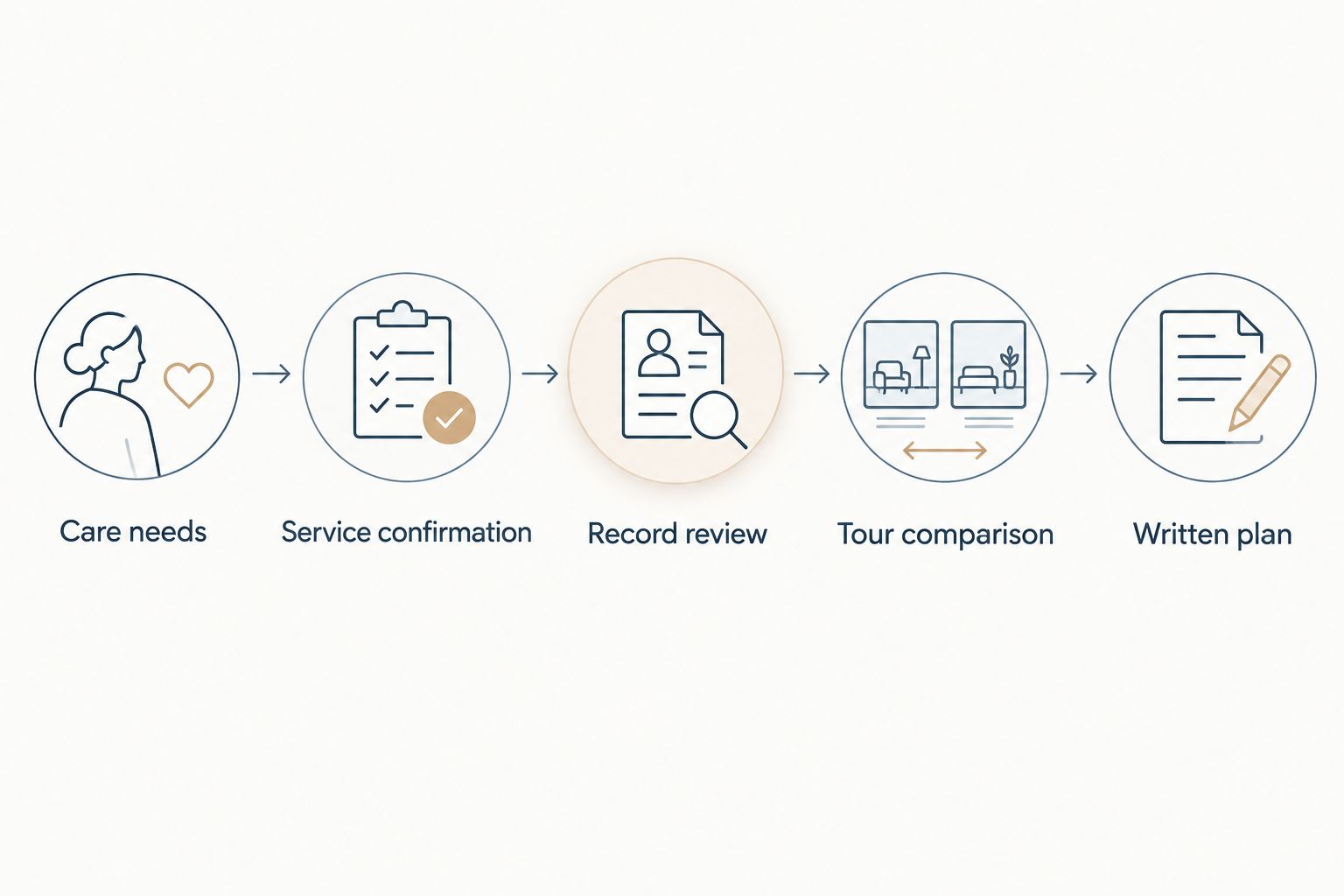
Confirm care fit before comparing the details of a move.
Ask questions that reveal the actual care plan
Choose 3 communities for an initial comparison if practical, then use the same notes for each. This is a manageable starting point, not a requirement to keep a poor fit on your list.
Ask each admissions team:
If practical, arrange 2 visits at different times. Use the second visit to clarify unanswered questions, not to repeat the same sales presentation. Ask permission before observing shared spaces, and respect residents’ privacy.
For Avina Healthcare or any other provider, direct these questions to the location being considered. A general explanation of the organization is not a substitute for a location-specific conversation.
Check official records before signing
For Wisconsin assisted living settings, consult Wisconsin Department of Health Services licensing and consumer information records. For Medicare-certified nursing homes, Medicare Care Compare provides facility information and inspection-related measures; Wisconsin DHS also provides nursing home regulatory information.
During a 2026 review, match the facility’s name, address, and care setting carefully. Read the dates and details behind a rating or inspection finding rather than treating a summary score as the whole picture.
Ask the community to explain relevant findings and corrective action. Official records and an admission assessment answer different questions: one addresses regulatory history, while the other addresses whether the program can support your loved one.
Which memory care option should you choose?
Start with residential memory care when the central need is a place to live with dementia-focused support. Start with a clinician’s nursing assessment when ongoing medical care is the main concern. Consider dementia-capable adult day services when the person’s home arrangement remains suitable outside program hours.
For a 2026 decision, choose the program that gives clear answers about both its capabilities and its limits. Do not commit based on a reassuring label, a furnished apartment, or a promise that staff can handle everything.
FAQ
What are the best memory care facilities in Kenosha?
The best fit is a program that confirms it can meet your loved one’s assessed dementia-related and daily care needs. Compare location-specific services, staffing arrangements, official records, and written care limits before choosing.
Is memory care the same as assisted living?
No. Memory care describes dementia-focused support, while assisted living is a broader care category. Confirm the individual program’s services rather than assuming all assisted living communities provide memory care.
Does Avina Healthcare offer memory care in Kenosha?
Yes, Avina on 32nd in Kenosha offers a secure, certificed memory care neighborhood where our specially trained team provides personalized care, music therapy and engaging, sensory-based activities that make each day more comfortable, familiar and fulfilling.
When should we consider skilled nursing instead of memory care?
Consider skilled nursing when a clinician identifies ongoing nursing needs that require that setting. The prospective facility must also assess whether it can support the person’s dementia-related needs.
Can adult day services replace residential memory care?
Adult day services do not replace overnight residential care. They fit someone who can continue living at home with appropriate support outside program hours.
What should I bring to a memory care tour?
Bring a written outline of daily routines, assistance needs, preferences, and questions. Ask how to provide medical records securely through the community’s admissions process.
One last thing
Ask one final question: What would make this community the wrong fit for my loved one? A useful answer names specific care limits and explains what would happen next. That conversation tells you more about a proposed placement than another look at the dining room.
