
Choosing a Kenosha nursing home in 2026 comes down to matching the level of care to the person, then checking the facility against federal inspection and staffing data. This guide ranks the care types you will find in Kenosha, WI and gives you the exact checks to run on any facility.
TL;DR
- Best overall for a Kenosha nursing home in 2026: any facility with a 4 or 5 star overall rating on Medicare Care Compare.
- Short-term rehab after a hospital stay is a different product from long-term nursing care. Shop for each separately.
- Staffing and health inspection stars matter more than the building or the brochure.
- Tour twice, once scheduled and once unannounced, before you sign anything.
Best overall: a Kenosha nursing home with a 4 or 5 star overall rating on Medicare Care Compare and a clean recent inspection record. Best for recovery after surgery or a hospital stay: a skilled nursing facility with an on-site therapy program. Best for dementia: a facility with a dedicated memory care unit and staff trained for it. Best for a short break for family caregivers: a facility that accepts respite stays.
Why this matters in 2026
The keyword kenosha nursing home pulls roughly 480 searches a month, and most of those searchers are in a hurry. A hospital discharge planner hands a family a list, and they have days to decide.
That pressure is how families end up choosing on proximity alone. Proximity matters for visits, but it is the third filter, not the first. The first two are the right level of care and the facility's public track record.
Every nursing home that takes Medicare or Medicaid is rated by the federal government. Those ratings are free, updated, and searchable by city. Use them.
What makes the best nursing home in Kenosha
Rank any facility against these six criteria before you visit:
- Overall star rating. Medicare Care Compare rates every certified nursing home from 1 to 5 stars. Treat 4 and 5 as the target and 1 or 2 as a reason to ask hard questions.
- Health inspection results. Look at the number and severity of citations, and whether the same issue repeats across inspections.
- Staffing. Check nurse staffing hours per resident and turnover. Thin staffing shows up first in call-light response and missed repositioning.
- Quality measures. These track things like pressure ulcers, falls with injury, and hospital readmissions.
- Fit for the care need. Rehab, long-term custodial care, and memory care are different programs. A good facility for one can be a poor fit for another.
- Payment fit. Confirm the facility accepts the payer you will use, whether Medicare, Wisconsin Medicaid, long-term care insurance, or private pay, before you tour.
Kenosha nursing home care types at a glance
Skilled nursing with rehab
- Best for: Recovery after surgery, stroke, or a fall
- Standout feature: Daily physical, occupational, and speech therapy
- Key limitation: Stays are usually short and tied to progress
Long-term nursing care
- Best for: Ongoing medical and personal care needs
- Standout feature: 24-hour nursing oversight
- Key limitation: Quality varies widely facility to facility
Memory care unit
- Best for: Alzheimer's disease and other dementia
- Standout feature: Secured space and trained staff
- Key limitation: Not every nursing home has a dedicated unit
Respite stay
- Best for: Family caregivers who need a break
- Standout feature: Short, defined stay
- Key limitation: Availability depends on open beds
Hospice-supported nursing care
- Best for: End-of-life comfort care
- Standout feature: Care focused on comfort and family support
- Key limitation: Not intended for recovery
1. Skilled nursing with rehab: best Kenosha nursing home for recovery
Skilled nursing with rehab is built for people who leave the hospital but are not ready to go home. The goal is to get stronger and return home.
Skilled rehab pros:
- Therapy is part of the daily schedule.
- Nurses are on site around the clock for wound care, IV medication, and monitoring.
- Medicare can cover a qualifying stay. The benefit generally requires a hospital inpatient stay of at least three days beforehand, and it covers up to 100 days per benefit period, with a daily coinsurance starting on day 21.
Skilled rehab cons:
- Coverage ends when you stop making measurable progress.
- Therapy intensity varies. Ask how many therapy minutes a resident gets per day.
- Rehab wings can be noisy and busy.
Best for: post-surgical and post-stroke recovery with a clear goal of returning home.
Verdict: Buy, as long as the facility publishes its rehab outcomes or will tell you its discharge-to-home rate.
2. Long-term nursing care: best for ongoing medical needs
Long-term care is for people who need help with most daily activities plus regular nursing attention. This is where the star ratings matter most, because the resident lives there, not just visits.
Long-term care pros:
- Nursing oversight is constant, so changes in condition get caught.
- Meals, medication, bathing, and mobility help are handled in one place.
- Medicaid can pay for long-term nursing home care when the resident meets the financial and functional requirements.
Long-term care cons:
- Quality swings between facilities even within the same city.
- Medicare does not pay for long-term custodial care.
- A move to a new room or unit can unsettle residents.
Best for: adults who can no longer be safely supported at home or in assisted living.
Verdict: Buy only after reading the last two inspection reports in full.
3. Memory care: best for dementia
A memory care unit is a secured area with staff trained in dementia behavior, routines, and communication. It is the right pick when wandering, sundowning, or safety risks have outgrown home care.
Memory care pros:
- Secured doors reduce wandering risk.
- Structured daily activity lowers agitation.
- Staff are trained for behaviors that general nursing staff may not handle well.
Memory care cons:
- Not every Kenosha nursing home has a separate unit. Ask directly.
- Staffing ratios on the unit matter more than the decor.
- Waitlists are common.
Best for: residents with moderate to advanced dementia.
Verdict: Buy when a dedicated unit exists. Skip facilities that only say they accept dementia residents.
4. Respite stays: best for family caregivers
A respite stay is a short, planned admission, often days to a few weeks, so a family caregiver can travel, recover, or rest. It is also a low-risk way to test a facility before a permanent move.
Respite pros:
- You see daily operations firsthand.
- It gives caregivers a real break.
- It can ease the transition into longer-term care.
Respite cons:
- Beds are limited and not every facility offers it.
- Payment is often private pay. Confirm before booking.
- The stay is short, so the resident has little time to settle.
Best for: caregivers who are burning out but not ready for a permanent decision.
Verdict: Buy as a trial run.
5. Hospice-supported nursing care: best for end-of-life comfort
Some residents receive hospice services inside a nursing home. The nursing home provides room and daily care while a hospice team manages comfort, pain, and family support.
Hospice-supported care pros:
- Comfort is the stated goal, which spares the resident repeated hospital trips.
- Family gets counseling and support.
- The resident stays in a familiar room.
Hospice-supported care cons:
- It is a different benefit from skilled rehab. The two usually do not run at the same time for the same condition.
- Coordination between the facility and the hospice agency has to be clear.
- The decision is emotionally hard for families.
Best for: residents whose care goals have shifted to comfort.
Verdict: Hold until the family and physician have talked through goals of care.
How the care types were ranked
The order follows how often each need drives a nursing home search and how directly the six criteria above can be checked in public data. Rehab and long-term care come first because most searches start there. Respite and hospice-supported care sit lower because they apply to narrower situations. No individual facility is scored here. Run the criteria against each Kenosha home on your shortlist.
How to check any Kenosha nursing home in 30 minutes
- Search the facility name on Medicare Care Compare and note the overall, health inspection, staffing, and quality stars.
- Open the most recent inspection report and read the citations, not just the star count.
- Call and ask for the current staffing for day, evening, and night shifts.
- Ask whether the specific care you need, such as memory care or rehab therapy, is offered on site.
- Confirm your payer is accepted.
- Tour once by appointment and once at an off hour, such as an evening or weekend.
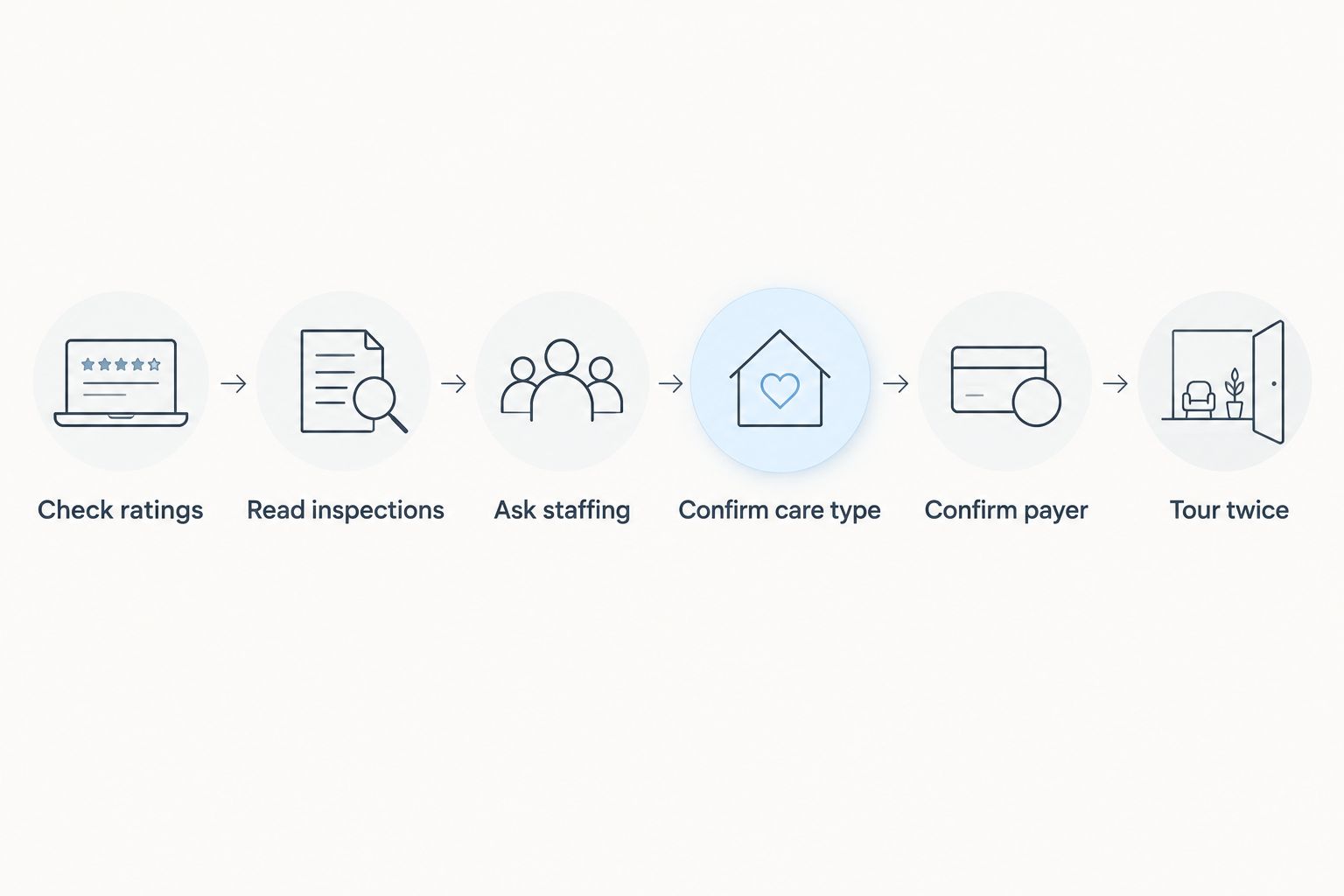
Ratings and inspections come before any tour.
On the tour, watch how staff talk to residents, how fast call lights are answered, and whether residents look clean and engaged. Smell matters too. Persistent odor points to a staffing problem.
Red flags to walk away from
- Overall rating of 1 or 2 stars with no credible explanation.
- The same inspection citation repeated across multiple years.
- Staff who cannot tell you who the director of nursing is.
- Pressure to sign admission paperwork on the first visit.
- Refusal to let you see the unit you would actually live on.
Questions to bring on your first call
- What is the current nurse-to-resident ratio on each shift?
- How many staff left in the past 12 months?
- Do you have a bed available for the care type I need?
- What does the daily rate include, and what costs extra?
- Who is my single point of contact after admission?
If you want help sorting options in the Kenosha area, you can start from the Avina Healthcare site.
Talk through your options
Start from the Avina Healthcare site and bring your shortlist.
Which Kenosha nursing home should you choose?
If the need is recovery, pick a skilled nursing facility with a strong therapy program and a 4 or 5 star rating. If the need is permanent care, put staffing and inspection history above everything else. If the need is dementia, require a dedicated memory care unit. If you are undecided, start with a respite stay at the highest-rated facility that fits your payer.
The default for 2026: filter Kenosha nursing homes to 4 and 5 stars on Medicare Care Compare, then choose the one that matches the care type and payer.
FAQ
What is the best nursing home in Kenosha, WI?
The best Kenosha nursing home for you is the one with a 4 or 5 star Medicare Care Compare rating that offers the care type you need. Ratings and inspections change, so check the current listing before you decide.
How do I check a Kenosha nursing home's quality?
Search the facility on Medicare Care Compare. It shows overall, health inspection, staffing, and quality measure ratings, plus inspection reports. Read the citations, not just the stars.
Does Medicare pay for a nursing home in Kenosha?
Medicare covers short-term skilled nursing and rehab after a qualifying hospital stay of at least three days, for up to 100 days per benefit period. It does not cover long-term custodial care.
Does Medicaid cover nursing home care in Wisconsin?
Wisconsin Medicaid can cover long-term nursing home care for residents who meet the financial and functional requirements. Confirm that your chosen facility accepts Medicaid before admission.
What is the difference between a nursing home and assisted living?
A nursing home provides 24-hour nursing care for people with significant medical needs. Assisted living helps with daily activities for people who are more independent and need less medical oversight.
Should I visit a nursing home unannounced?
Yes. Tour once by appointment, then return at an off hour such as an evening or weekend. Staffing and responsiveness are easier to judge when the facility is not expecting you.
Can I try a Kenosha nursing home before committing?
Ask about respite stays. A short admission lets you see daily care firsthand, though availability and payment terms vary by facility.
One last thing
The staffing star on Medicare Care Compare is the single best early signal of daily care quality. A facility with a high overall rating but a low staffing rating deserves extra questions, because staffing is what the resident feels every shift in 2026.